LearnStitch and finish
How to wash, iron and frame a finished cross stitch
Hand-wash a finished cross stitch in cool or lukewarm water with a little mild soap, rinse until the water runs clear, and roll it in a towel without wringing. Press it face down on a thick towel while it is still slightly damp, so the stitches stay raised. Then frame it over acid-free board, finish it in a hoop, or take it to a framer.
On this page
The last stitch is not quite the end. A wash lifts out hand oils and hoop marks, a press makes the fabric flat and the stitches plump, and a good mount keeps the piece straight for years. None of it is hard, and it is worth an evening.
Before you wash
- Check for missed stitches. Hold the piece against the light and compare it with the chart, colour by colour.
- Tidy the back. Trim loose tails to about half a centimetre and make sure every thread end is woven under stitches.
- Leave the extras off. Beads, buttons and charms go on after washing and pressing, so the iron never touches them.
- Remove marking pen with water, if you gridded with a water-soluble pen. Heat can set it, so never iron first. Air-erasable and heat-erasable pens have their own rules: check the pen’s packet.
Test the colours
Most stranded cotton is made not to run, but strong reds, deep blues and hand-dyed threads can still bleed. Test before you soak the whole piece:
- Dampen a white cotton cloth or cotton bud and press it on the darkest and brightest colours for a few seconds.
- If colour comes off, do not wash the piece. Press it as it is, or ask the thread maker or a textile cleaner what they advise for that thread.
If the water turns coloured while you wash or rinse, stop washing. Take the piece out, rinse it in cold water until the water stays clear, roll it in a towel at once and dry it flat: dye left to dry in the fabric sets as a stain.
How to wash a cross stitch
- Fill a clean basin with cool or lukewarm water and add a few drops of mild, dye-free soap. Avoid bleach and detergents with brighteners.
- Lay the piece in and let it soak for 10 to 15 minutes. Swish it gently; do not rub or scrub the stitches.
- Rinse in cool water, changing it until no soap is left and the water is clear.
- Lay the piece on a clean white towel, roll the towel up, and press on the roll to take out the water. Never wring it.
- Unroll it. It should be damp, not wet.
Do not tumble-dry it or dry it in direct sun.
How to iron a cross stitch
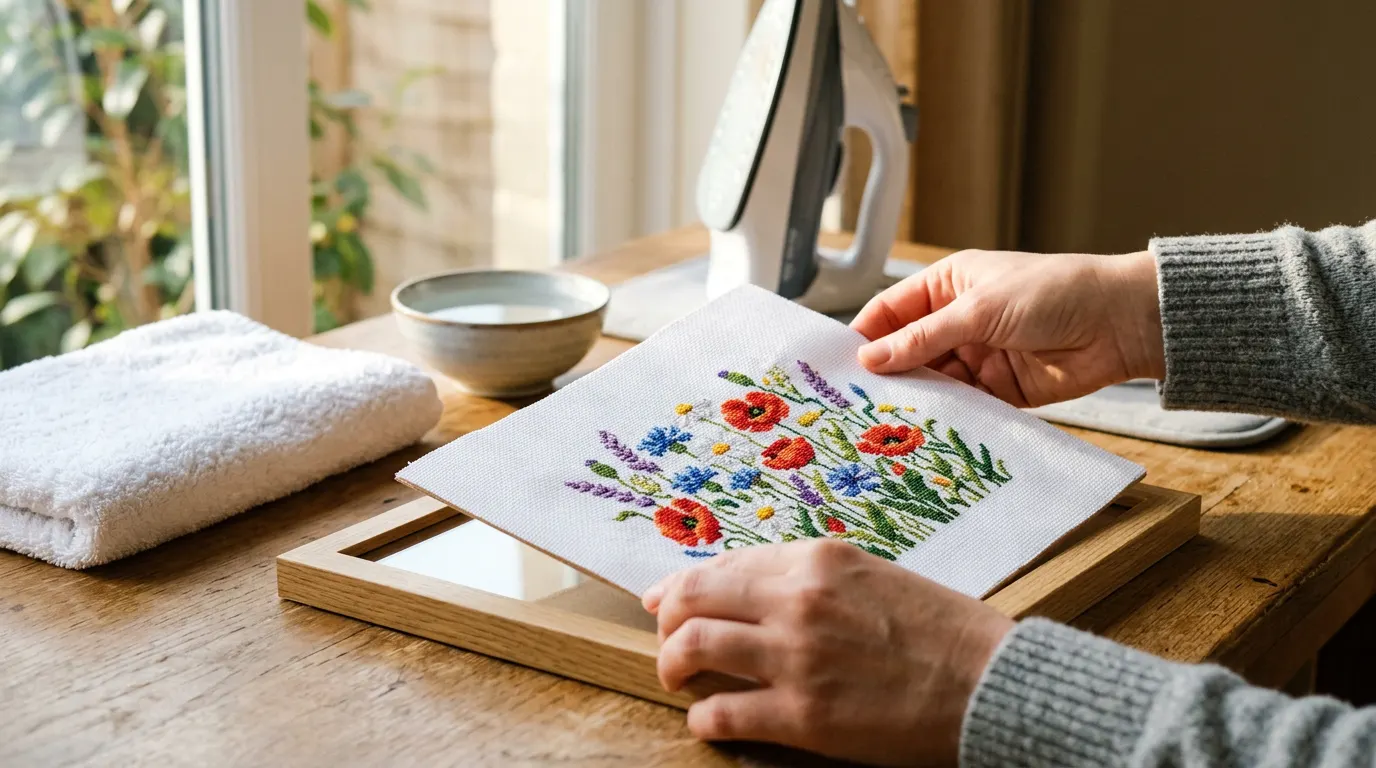
Press while the piece is still damp, face down, so the stitches sink into something soft instead of being flattened.
- Fold a thick, fluffy towel on the ironing board.
- Lay the stitching on it face down, with the fabric’s grid straight.
- Cover it with a thin pressing cloth if you have one.
- Use a warm iron, never a hot one, and set it for the most delicate material in the piece: metallic, rayon and synthetic threads, and blended or synthetic fabrics, need a lower setting than cotton. Press down, lift and move; sliding the iron can stretch Aida out of square.
- Keep going until the fabric is dry, then let it lie flat for an hour before you mount it.
Even on a low setting, press around metallic threads rather than over them. Hoop creases that a first press does not lift usually go with a little more steam.
How to frame a cross stitch
Leave enough fabric
You need spare fabric all round to fold over a board: plan on 5–8 cm (2–3 in) on each side of the design, more for a large piece. The fabric calculator adds this margin for you before you buy.
Lace it over a board
The classic way, and the one that keeps the grid straightest:
- Cut acid-free mount board or foam board to the size of the frame’s opening.
- Centre the stitching on it, face up, and fold the spare fabric round to the back. Pins pushed into the edge of the board hold it while you work.
- Lace across the back with strong thread, from one long side to the other, in a zig-zag. Pull each stitch firm so the fabric is taut.
- Lace the other two sides the same way, folding the corners in neatly.
- Check from the front that the rows of holes run straight, and adjust before the last knot.
Lacing can come undone later without leaving marks. Self-adhesive boards and glue are quicker, but they can stain and are hard to undo.
Glass or no glass
- Glass keeps off dust and light, but pressed against the stitches it flattens them. Use a mount (mat) or spacers so it does not touch.
- No glass shows the texture of the stitches best; dust it now and then.
- Glass that filters UV light helps a piece hung near a window keep its colours.
At a framer
Ask for acid-free materials, no glue on the stitching itself, and a mount or spacer that keeps the glass off. Bring the piece pressed and clean.
In a hoop
Quick and popular for small pieces:
- Mount the stitching in a hoop, centred and drum-tight, and tighten the screw.
- Trim the spare fabric to 3–4 cm (about 1½ in) all round.
- Run a gathering stitch round the edge on the back and pull it so the fabric folds in.
- Glue or stitch a circle of felt over the back to cover it.
Other finishes include a cushion, an ornament, a card or a bookmark. A finished-and-framed piece is what stitchers call an FFO; see the glossary.
Before you take it out of the hoop
In Crosstela you can check what is left before you wash: the Stitches tab of the Palette counts what is left of each kind, including backstitch, French knots and beads, and a tap on a colour shows how many of its stitches remain. A four-finger tap on the chart shows the finished piece. See Half stitches, knots and beads.
Once you are done, the progress panel can play your piece growing, stitch by stitch, in the order you marked it. Tap the percentage, then Time-lapse under Day by day, and share it as a video. See Watch and share your time-lapse.
Crosstela is free, for iPhone, iPad and Mac.
Questions people ask
Should I wash my cross stitch before framing?
It is a good idea if it was in a hoop, handled a lot, or marked with a water-soluble pen. A piece that is clean and flat can be pressed without washing.
Can you put cross stitch in the washing machine?
It is best not to. Hand-wash it in cool water with mild soap and roll it in a towel to dry. A machine and a dryer can distort the fabric and loosen the stitches.
How do you iron cross stitch without flattening it?
Iron it face down on a thick, fluffy towel, while it is still slightly damp. The towel cushions the stitches so they stay raised.
How do I get hoop marks out of cross stitch?
Wash it and press it while damp, face down on a towel, with plenty of steam. Most hoop marks go. To avoid them, take the fabric out of the hoop when you stop for the day.
Do you put glass over cross stitch?
You can, but keep it off the stitches with a mount or spacers, or the glass will flatten them. Without glass the texture shows best but the piece collects dust.