Crosstela LearnНавчання Get the appЗавантажити застосунок

LearnStart stitching

Cross-stitch glossary

This glossary explains the words cross stitchers use for fabric, thread, stitches, charts and techniques, from Aida and count to parking, confetti and FFO. Each term has a short, plain definition, with a link to a fuller guide where there is more to learn.
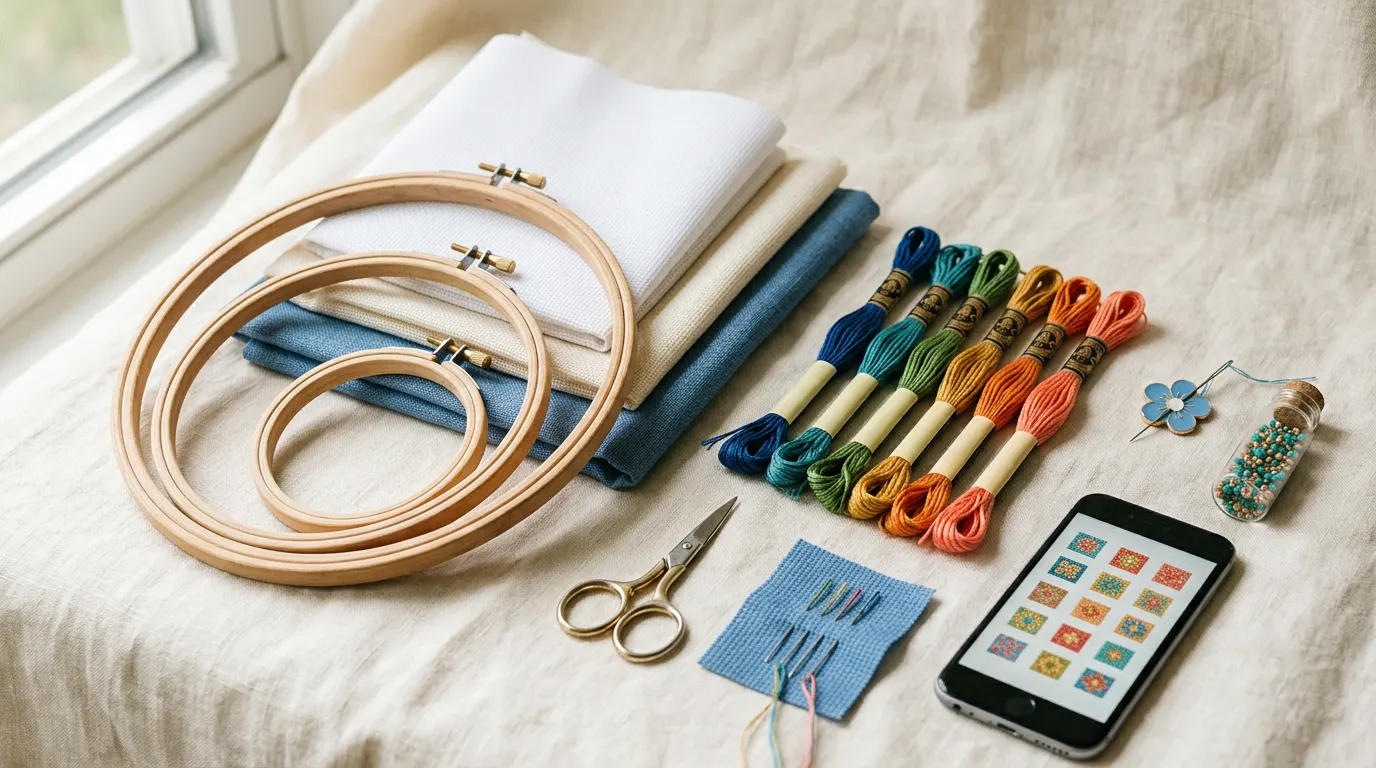
Cross-stitch materials laid out: folded Aida and evenweave in white, cream and blue, wooden hoops in three sizes, skeins of floss, needles and a phone showing a chart.
On this page
  1. Fabric
  2. Thread
  3. Needles and frames
  4. Stitches
  5. Charts
  6. Techniques
  7. Community words
  8. Questions people ask

Cross stitch has its own vocabulary, and much of it is shorthand from forums and kits. Here are the terms you will meet most, grouped by subject.

Fabric

Aida

A cotton cloth woven in small blocks with a hole at each corner, made for cross stitch. Each block takes one cross, so you can see exactly where every stitch goes.

Count

How fine the cloth is. On Aida it is the squares to the inch, one cross in each: 14-count Aida takes 14 crosses to the inch, about 5.5 to the centimetre. On evenweave and linen it is the cloth’s threads to the inch; stitched over two, that gives half as many stitches, so 28-count linen over two takes 14 to the inch. A higher count gives a smaller, finer result.

Evenweave

A cloth of single threads of even thickness, the same number each way. It is usually 25 to 32 count and stitched over two.

Linen

Cloth woven from flax. Its threads vary in thickness, which gives it a natural look but makes counting harder. It is stitched over two, like evenweave.

Over two

Each cross covers two threads of the cloth each way. On 28-count evenweave, over two gives 14 stitches to the inch, the same size as 14-count Aida.

Thread

Floss

Embroidery thread, usually six-strand cotton, sold by brands such as DMC, Anchor and Gamma under numbered shades. A pattern names the brand and number for every colour.

Strands

The six thin threads that make up floss. You separate them and stitch with one, two or three, depending on the count: two is usual on 14-count Aida.

Skein

The small bundle floss is sold in, held by paper bands that give the brand and shade number. A DMC six-strand skein holds 8 metres.

Bobbin

A flat card of plastic or cardboard that floss is wound onto, with its shade number written on it, so threads stay sorted and untangled.

Blended needle

Two different shades in one needle, often one strand of each, to make a colour in between. The key lists both numbers in one row.

Needles and frames

Tapestry needle

A needle with a blunt tip and a long eye, made for counted cloth. A higher number is a finer needle: 24 for 14-count Aida, 26 for 16- and 18-count.

Hoop

Two rings, usually of wood or plastic, that hold the cloth taut between them; the outer one tightens with a screw. Take the cloth out when you stop for the day to avoid ring marks.

Q-snap

A square or rectangular frame of plastic tubes, with clips that snap over the cloth. It holds the cloth taut and presses less on finished stitches than a hoop.

Scroll frame

A frame with two rollers: the cloth is rolled onto them, so a large piece stays taut and only the part you are working on is open.

Stitches

All of these are described step by step in the stitch library.

Full cross

The basic stitch: two diagonal stitches crossing in one square. Every top leg in a piece should lie the same way.

Half stitch

One diagonal leg of a cross, across a whole square. It gives a lighter texture for shading, skies and backgrounds.

Quarter stitch

A diagonal stitch from one corner of a square to its centre. It fills part of a square, usually where two colours meet.

Three-quarter stitch

A half stitch and a quarter stitch in the same square. It smooths curves and diagonal edges; charts often draw it as a triangle filling half the square.

Petite stitch

A tiny cross in one quarter of a square. On Aida the needle pierces the middle of the block. It is used for fine detail such as eyes.

Backstitch

Straight stitches from hole to hole that make outlines and lettering, usually worked after the crosses and often with one strand.

French knot

A small raised knot made by wrapping the thread round the needle and going back down next to where it came up. It makes eyes, dots and flower centres.

Bead

A small glass bead sewn onto a square with a thin beading needle. Beads go on after the stitching around them.

Specialty stitch

Any stitch beyond crosses and backstitch, such as an Algerian eye, a Smyrna cross or satin stitch. Charts explain each on a page of its own.

Charts

Chart

The pattern as a grid of squares, one per stitch, with a symbol or colour in each and a key that names the threads.

PDF pattern

A chart sold or shared as a PDF file, usually with a cover page, the key and the chart split across pages. Crosstela opens PDF patterns saved by a design program and lets you mark each stitch as you go; a scan or photo of a paper chart is not read. See Track a PDF pattern.

Key

The table that says which thread each symbol stands for, with brand, shade number and strands, and often how many skeins you need. Also called the legend.

Symbol

The mark in a chart square that stands for one thread. A black-and-white chart relies on symbols alone; a colour chart adds colour behind them. See how to read a pattern.

Tens lines

The bolder grid lines every ten squares. They make counting easier. In Crosstela, Tools › Grid draws lines every five or ten squares and marks the centre.

Full coverage

A design in which every square is stitched and no bare cloth shows. Full-coverage charts are often made from paintings and have many colours and much confetti.

Confetti

Single stitches of one colour scattered among other colours. It is common in full-coverage and photo-based patterns; see turn a photo into a pattern.

Techniques

Loop start

A way to start without a knot: fold one strand in half, thread both ends through the needle, make the first half stitch and pass the needle through the loop on the back. It works for an even number of strands.

Waste knot

A knot made on the front of the cloth a few centimetres from your first stitch, in line with the row you will stitch. The stitches cover its thread on the back; when they reach the knot, you cut it off.

Away knot

A knot made on the front well away from where you will stitch, so no stitch covers its thread. When the area is done, you cut the knot off and weave the tail in under a few stitches on the back.

Tails

The short ends of thread left at the back when you start or finish. They are covered by stitches or run under them, not knotted.

Gridding

Running a thin thread, or using a washable pen, along every tenth line of the cloth to match the chart's tens lines. The thread comes out when the stitching is done.

Parking

Stitching in small blocks and, when a colour is done in one block, bringing its needle up where that colour starts next and leaving it there. It keeps many colours going without long threads across the back. See the parking method; in Crosstela you can park a thread on the chart.

Cross-country

Stitching one colour across a whole area before changing to the next. It suits patterns with large patches of colour.

Railroading

Passing the needle between the two strands of a stitch so they lie flat, side by side, instead of twisting. It takes a little longer and gives smoother coverage.

Frogging

Unpicking stitches. The name comes from "rip it, rip it", which sounds like a frog.

Community words

BAP

"Big ass project": a very large chart, often full coverage, that takes months or years.

HAED

Heaven and Earth Designs, a pattern company known for very large full-coverage charts made from paintings and art.

WIP

Work in progress: a project started and not yet finished. Many stitchers keep several WIPs and rotate between them.

FFO

Fully finished object: stitched and made up, framed or sewn into a cushion or an ornament. An FO, finished object, has its stitching done but is not yet made up.

SAL

Stitch-along: a group stitches the same pattern on a shared schedule, often with parts released one at a time, and shares progress.

Stash

The threads, cloth, patterns and kits a stitcher keeps for future projects.

Questions people ask

What does 14-count mean in cross stitch?

On Aida it means 14 squares, so 14 crosses, to the inch, about 5.5 to the centimetre. A design 140 stitches wide comes out 10 inches (25.4 cm) wide on 14-count.

What is the difference between Aida and evenweave?

Aida is woven in blocks with clear holes, and each cross covers one block. Evenweave has single, even threads and is usually stitched over two, which gives a finer look and allows fractional stitches more easily.

What is confetti in cross stitch?

Confetti means single stitches of one colour scattered among other colours. Each one needs its own start and finish, so stitchers often work it with the parking method.

What do WIP, FFO and SAL mean?

WIP is a work in progress, FFO a fully finished object (stitched and made up), and SAL a stitch-along, where a group stitches the same pattern on a shared schedule.

НавчанняПерші кроки

Словник вишивальниці: терміни вишивки хрестиком

Цей словник пояснює слова, якими вишивальниці говорять про канву, нитки, стібки, схеми й техніки, — від Аїди й каунту до паркування, конфеті й FFO. Кожен термін має коротке й просте пояснення, а де є що вивчати далі, — посилання на докладнішу статтю.

Матеріали для вишивки: складена канва Аїда й рівномірна тканина білого, кремового та синього кольорів, дерев'яні п'яльця трьох розмірів, мулине, голки й телефон зі схемою.
На цій сторінці
  1. Тканина
  2. Нитки
  3. Голки й п'яльця
  4. Стібки
  5. Схеми
  6. Техніки
  7. Слова спільноти
  8. Часті питання

У вишивки хрестиком є своя мова, і багато в ній — скорочення з форумів і наборів. Ось терміни, які трапляються найчастіше, згруповані за темами.

Тканина

Аїда

Бавовняна канва, виткана маленькими квадратиками з дірочкою в кожному куті, створена саме для хрестика. На кожен квадратик лягає один хрестик, тож видно, куди йде кожен стібок.

Каунт

Наскільки дрібна канва. На Аїді це кількість квадратиків на дюйм (2,54 см), по хрестику в кожному: Аїда 14 — це 14 хрестиків на дюйм, приблизно 5,5 на сантиметр. На рівномірці й льоні це кількість ниток тканини на дюйм; якщо вишивати через дві нитки, хрестиків виходить удвічі менше, тож льон 28 через дві дає 14 хрестиків на дюйм. Що більший каунт, то менша й тонша вишивка.

Рівномірка

Тканина з окремих ниток однакової товщини, з однаковою кількістю ниток в обидва боки. Зазвичай це 25–32 каунт, і вишивають її через дві нитки.

Льон

Тканина з лляних ниток. Нитки в ній різної товщини: це дає природний вигляд, але рахувати важче. Вишивають через дві нитки, як рівномірку.

Через дві нитки

Кожен хрестик накриває по дві нитки тканини в кожен бік. На рівномірці 28 каунт це дає 14 хрестиків на дюйм — той самий розмір, що й на Аїді 14.

Нитки

Мулине

Нитки для вишивки, зазвичай бавовняні, із шести тонких ниточок. Їх випускають DMC, Gamma, Anchor та інші бренди під номерами відтінків, і схема вказує бренд і номер для кожного кольору.

Кількість ниток

Скільки з шести ниточок мулине йде в голку. Їх розділяють і вишивають в одну, дві чи три залежно від каунту: на Аїді 14 зазвичай у дві.

Моток

Невелике пасмо мулине в паперових кільцях з брендом і номером відтінку. Моток DMC має 8 метрів.

Бобінка

Пласка картонка чи пластинка, на яку намотують мулине й пишуть номер, щоб нитки не плуталися й лежали по порядку.

Бленд (змішані нитки)

Два різні відтінки в одній голці, часто по одній нитці кожного, щоб вийшов проміжний колір. У ключі такий рядок має два номери.

Голки й п'яльця

Голка з тупим кінчиком

Голка для вишивки з тупим кінчиком і довгим вушком, створена для лічильної канви. Що більший номер, то тонша голка: № 24 для Аїди 14, № 26 для Аїди 16 і 18.

П'яльця

Два кільця, зазвичай дерев'яні чи пластикові, що тримають канву натягнутою; зовнішнє затягується гвинтом. Виймайте канву, коли закінчуєте на день, щоб не лишилося сліду.

Q-snap

Квадратна чи прямокутна рамка з пластикових трубок, на які защіпаються кліпси з канвою. Вона тримає натяг і менше тисне на вишиті хрестики, ніж п'яльця.

Рамка з валиками

Рамка з двома валиками, на які намотують канву: велика робота лишається натягнутою, а відкрита тільки та частина, яку ви вишиваєте.

Стібки

Усі вони покроково описані в бібліотеці стібків.

Повний хрестик

Основний стібок: два діагональні стібки, що перехрещуються в одній клітинці. Верхні стібки всіх хрестиків у роботі мають лежати в один бік.

Півхрестик

Один діагональний стібок через усю клітинку. Дає легшу фактуру для тіней, неба й тла.

Чверть хрестика

Діагональний стібок від кута клітинки до її центру. Заповнює частину клітинки, зазвичай там, де зустрічаються два кольори.

Три чверті хрестика

Півхрестик і чверть хрестика в одній клітинці. Згладжує вигини й діагональні краї; у схемах його часто малюють трикутником на пів клітинки.

Петит

Крихітний хрестик у чверті клітинки. На Аїді голку проколюють посередині квадратика. Ним вишивають дрібні деталі, як-от очі.

Бекстіч

Прямі стібки від дірочки до дірочки, якими вишивають контури й написи, зазвичай після хрестиків і часто в одну нитку.

Французький вузлик

Маленький об'ємний вузлик: нитку обмотують навколо голки й вводять поруч із місцем, де вона вийшла. Ним роблять очі, цятки й серединки квітів.

Бісер

Дрібна скляна намистинка, яку пришивають до клітинки тонкою голкою для бісеру. Бісер пришивають після вишивки довкола.

Спеціальні стібки

Усі стібки, крім хрестиків і бекстічу, як-от алжирське вічко, хрестик «Смірна» чи гладь. Схема пояснює кожен на окремій сторінці.

Схеми

Схема

Візерунок у вигляді сітки клітинок, по одній на хрестик, із символом чи кольором у кожній і ключем, що називає нитки.

PDF-схема

Схема, яку продають чи пересилають файлом PDF: зазвичай обкладинка, ключ і сама схема, поділена на сторінки. Crosstela відкриває PDF-схеми, збережені програмою для дизайну, і дає позначати кожен хрестик; скан чи фото паперової схеми вона не читає. Див. PDF-схема в застосунку.

Ключ

Таблиця, яка каже, якій нитці відповідає кожен символ: бренд, номер відтінку, кількість ниток, а часто й скільки мотків потрібно. Його ще називають легендою.

Символ

Значок у клітинці схеми, що позначає одну нитку. Чорно-біла схема тримається лише на символах, кольорова додає під них колір. Див. як читати схему.

Десятки

Жирніші лінії сітки через кожні десять клітинок. З ними легше рахувати. У Crosstela Інструменти › Сітка малює лінії кожні п'ять чи десять клітинок і позначає центр.

Суцільна вишивка

Дизайн, у якому вишито кожну клітинку і канви не видно. Такі схеми часто роблять з картин, у них багато кольорів і багато конфеті.

Конфеті

Поодинокі хрестики одного кольору, розкидані серед інших. Часто трапляються в суцільних схемах і схемах з фото; див. схема для вишивки з фото.

Техніки

Старт петлею

Спосіб почати без вузлика: одну нитку складають навпіл, обидва кінці просилюють у голку, роблять перший півхрестик і з виворота пропускають голку в петлю. Підходить для парної кількості ниток.

Тимчасовий вузлик на лиці

Вузлик на лицьовому боці канви за кілька сантиметрів від першого хрестика, на лінії ряду, який ви вишиватимете (англійською — waste knot). Стібки закривають його нитку з виворота, а коли дійдуть до вузлика, його зрізають.

Далекий вузлик

Вузлик на лицьовому боці далеко від місця вишивки, тож жоден стібок не накриває його нитку (англійською — away knot). Коли ділянку закінчено, вузлик зрізають, а кінчик протягують на звороті під кількома стібками.

Хвостики

Короткі кінці нитки з виворота на початку й наприкінці. Їх закривають стібками або протягують під ними, а не зав'язують.

Розмітка канви

Тонка нитка чи змивний маркер уздовж кожної десятої лінії канви, щоб вона збігалася з десятками на схемі. Нитку розмітки виймають, коли вишивку закінчено.

Паркування

Вишивання невеликими блоками: коли колір у блоці закінчено, голку з ним виводять там, де цей колір починається далі, і лишають. Так можна вести багато кольорів без довгих протяжок з виворота. Див. паркування ниток; у Crosstela нитку можна припаркувати прямо на схемі.

Крос-кантрі

Вишивання одним кольором по всій ділянці, перш ніж братися за наступний. Підходить для схем з великими плямами кольору.

Рейлроудинг

Голку проводять між двома нитками стібка, щоб вони лягли рівно, поруч, а не перекручувалися. Це трохи довше, зате хрестики гладші.

Розпорювання

Англійською — frogging: кажуть, «rip it, rip it» звучить як кумкання жаби. У нас просто розпорюють.

Слова спільноти

BAP

Від англійського «big ass project»: дуже велика, часто суцільна робота, яку вишивають місяцями чи роками.

HAED

Heaven and Earth Designs — компанія, відома дуже великими суцільними схемами за картинами й артом.

Процес (WIP)

Робота, яку почали й ще не закінчили; англійською WIP, work in progress. Багато вишивальниць ведуть кілька процесів і вишивають їх по черзі.

FFO

Повністю оформлена робота: вишита й оформлена в рамку, подушку чи іграшку. FO — вишивку закінчено, але ще не оформлено.

СП (SAL)

Спільний процес: група вишиває ту саму схему за спільним графіком, часто частинами, і ділиться прогресом.

Запаси

Нитки, канва, схеми й набори, які вишивальниця тримає для майбутніх робіт; англійською stash.

Часті питання

Що означає Аїда 14?

Це канва, на якій уміщається 14 хрестиків на дюйм, приблизно 5,5 на сантиметр. Дизайн шириною 140 хрестиків на Аїді 14 займе 25,4 см.

Чим Аїда відрізняється від рівномірки?

Аїда виткана квадратиками з чіткими дірочками, і хрестик накриває один квадратик. Рівномірка має окремі рівні нитки, її зазвичай вишивають через дві, і вона дає тоншу роботу та простіше приймає дробові стібки.

Що таке конфеті у вишивці?

Конфеті — це поодинокі хрестики одного кольору серед інших. Кожен потребує окремого закріплення, тому їх часто вишивають методом паркування.

Що означають процес, FFO і СП?

Процес (WIP) — розпочата й не закінчена робота, FFO — повністю оформлена робота, а СП (SAL) — спільний процес, коли група вишиває одну схему за спільним графіком.