LearnStart stitching
How many strands of floss for cross stitch?
Use 2 of the 6 strands for cross stitch on 14-count Aida, and 1 for backstitch. Use 3 strands on 11-count, 2 on 16- and 18-count, 1 on 22-count, and 2 on 28- or 32-count evenweave stitched over two. When the chart's key gives a number, follow the key.
On this page
Six-strand embroidery floss (stranded cotton: DMC, Anchor, Gamma and the rest) is made to be split. You choose how many strands go into the needle, and that choice decides how full and smooth your crosses look.
Strands by fabric count
| Fabric | Stitches per inch | Cross stitch | Backstitch |
|---|---|---|---|
| Aida 6 to 8 | 6–8 | 4 | 3 |
| Aida 10, 11 | 10–11 | 3 | 2 |
| Aida 14 | 14 | 2 | 1 |
| Aida 16 | 16 | 2 | 1 |
| Aida 18 | 18 | 2 (1 for a lighter look) | 1 |
| Aida 20, 22 | 20–22 | 1 | 1 |
| Evenweave or linen 25–36, over two | 12.5–18 | 2 | 1 |
| Linen over one, or 40-count over two | 20 or more | 1 | 1 |
The rule underneath is simple: the smaller the squares, the fewer strands fit through the holes. For backstitch, a common default is one strand fewer than the crosses, but never fewer than one; when the designer’s key gives a number, the key wins. This default is also what Crosstela uses when a pattern does not say.
For what each count means and the needle that suits it, see Aida and other fabric counts.
The chart’s key comes first
Designers often write the strands in the key, such as 2 strands cross stitch, 1 strand backstitch, or give a different number for one colour, for French knots, or for a blend. Their number was chosen for that design, so follow it over any table, including this one.
Two other things a key may ask for:
- A blend: one strand each of two colours in the same needle, to make a shade between them.
- Half stitches in one strand: a light, see-through layer for skies and shadows.
More or fewer strands
How many strands is partly taste. Coverage is how much of the fabric your crosses hide.
- More strands give full, rich crosses that hide the fabric. Too many crowd the holes, the stitches look lumpy, and Aida can distort.
- Fewer strands give a lighter, flatter look with the fabric showing through. Some stitchers like 1 strand on 18-count for a delicate piece.
- Dark fabric shows through gaps more, so you may want the fuller choice.
- Your tension matters too: a gentle pull lets strands spread and cover more.
Not sure? Stitch three or four crosses in a corner of the fabric with 2 strands and with 3, and look at them from arm's length.
How to separate strands
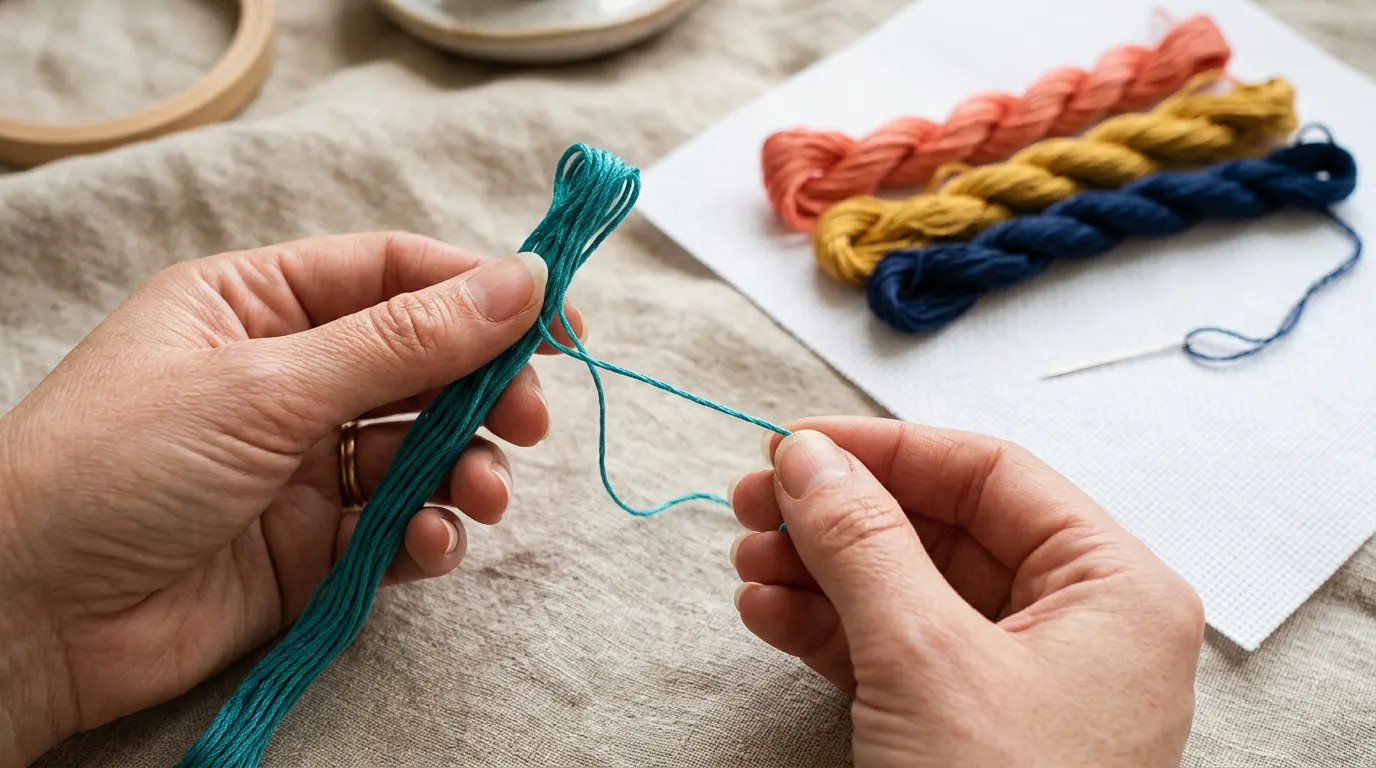
Even when you stitch with 2 strands, take them out one at a time and put them back together. Separated strands lie side by side instead of twisted, so they cover better and lie flat. Stitchers call this stripping the floss.
- Cut a length about 45 cm (18 in) long, roughly forearm to fingertips.
- Pinch the six strands at one end between finger and thumb. Fan the very end a little so you can see each strand.
- Hold the bundle and pull one strand straight up and out, slowly. The rest bunches up below your fingers; that is fine.
- Let the bundle hang for a moment and it untwists itself. Pull the next strand.
- Lay the strands you need next to each other, ends even, and thread them together.
Pulling two strands at once, or pulling sideways, is what makes the rest knot. If they tangle, let the bundle hang and the twist will run out. Keep the leftover strands on a card or bobbin with the colour number, so you can use them later.
Other threads
The table is for six-strand cotton. Other threads work differently:
- Pearl cotton (coton perlé) cannot be split; it is used as a single thread on larger fabric.
- Metallic and blending filament are usually stitched as one strand, often together with a strand or two of cotton.
- Wool and silk have their own weights; follow the key or the thread maker’s advice.
Strands and the floss you will need
More strands use more floss. Two strands use twice as much as one, so a chart stitched in 3 strands on 11-count needs far more skeins than the same chart in 2 strands on 14-count. The skeins calculator takes your count and your strands into account.
In the app
In Crosstela, press and hold a colour on the rail beside the chart, or in the Palette. Its menu shows Strands with the number in force, such as Strands · 2: the number the pattern gives, or yours. Choose from 1 to 6 to set your own for that colour; the item that says as the pattern takes yours back. See Stitch one colour at a time.
Crosstela is free, for iPhone, iPad and Mac.
Your next step
Look at the key of the chart you are about to stitch: it says how many strands to use for crosses and for backstitch. If it says nothing, use the table above for your cloth. Then work out how many skeins to buy with the skein calculator.
Questions people ask
How many strands do you use for cross stitch on 14-count Aida?
Two strands for the crosses and one for backstitch. That is the usual choice and the one most kits on 14-count use.
How many strands for 18-count Aida?
Two strands give full coverage; one gives a lighter, more delicate look. Backstitch is one strand.
How many strands for 28-count evenweave?
Stitched over two threads, 28-count gives 14 stitches to the inch, so use 2 strands, as on 14-count Aida. Over one, use 1.
Why separate all six strands if I only need two?
Separated strands lie flat and side by side, so the crosses look smoother and cover the fabric better than two strands still twisted together.
Do I use the same number of strands for backstitch?
Usually one fewer than for the crosses, often a single strand. The chart's key may say otherwise for an outline that should stand out.