LearnStart stitching
Cross stitch for beginners: what you need and your first pattern
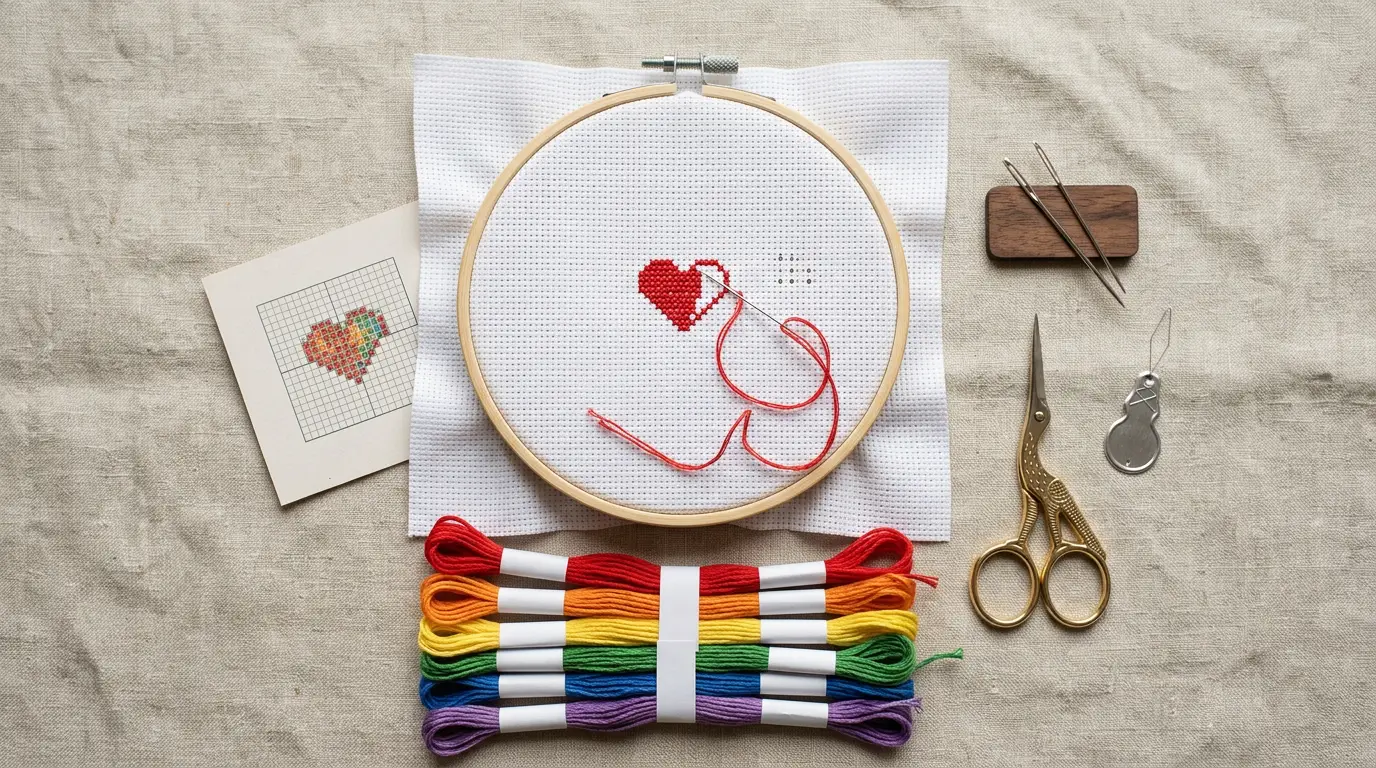
To start cross stitch you need Aida cloth (14-count is the usual first choice), six-strand cotton floss, a blunt tapestry needle, small scissors and, if you like, an embroidery hoop. Choose a small pattern with few colours and only full crosses, start from the centre without a knot, and make every cross with its top leg lying the same way.
On this page
Cross stitch is counted embroidery: a chart shows a grid of squares, and you make one X over each square of the cloth in the colour the chart gives. You need very little to begin.
What to buy
For a first small piece, this is the whole list:
- Aida, 14-count, white or light. Size it from the pattern: the free Strawberries chart is 56 × 45 stitches, so a piece of cloth about 20 × 18 cm (8 × 7 in) leaves room to frame it.
- Six-strand cotton floss in the colours of the pattern’s key. Strawberries takes one skein of each of its 8 colours.
- A size 24 tapestry needle.
- Small, sharp scissors.
- A hoop, if you want one. Aida is stiff enough to stitch in the hand.
For any other pattern or count, the fabric calculator and the skein calculator work out what to buy. The sections below say why each of these is the usual choice. A kit packs the same things, and a chart, into one box.
Fabric: Aida and its count
Aida is woven in little blocks with a clear hole at each corner, so you can see where every stitch goes. Its count is how many squares it has to the inch.
| Count | Squares per inch | About per cm | Good for |
|---|---|---|---|
| 11 | 11 | 4.3 | Big squares, easy on the eyes |
| 14 | 14 | 5.5 | Most kits and first projects |
| 16 | 16 | 6.3 | Finer look, same stitches |
| 18 | 18 | 7.1 | Small, detailed work |
So 14-count means 14 stitches to the inch. A higher count makes the same design smaller.
Evenweave and linen have single threads instead of blocks. They are stitched over two: each cross covers two threads each way, so 28-count over two gives 14 stitches to the inch. Linen's threads vary in thickness, which makes it harder to count. Start on Aida in white or a light colour.
Thread: six-strand cotton
Embroidery floss (stranded cotton) comes in skeins of six thin strands twisted together. You stitch with only some of them.
- Cut a length about as long as your forearm to your fingertips; longer pieces tangle and wear thin.
- Pull one strand straight up out of the bundle while you hold the rest. Then take the next.
- Lay the strands you need side by side again. Separated strands lie flatter and cover better.
| Aida count | Strands for crosses |
|---|---|
| 11 | 3 |
| 14 | 2 |
| 16 | 2 |
| 18 | 1 or 2 |
Backstitch usually takes one strand fewer, often a single strand. More counts, and how to choose, in how many strands to use.
Needles
Use a tapestry needle: its tip is blunt, so it slips through the holes without splitting the cloth, and its eye is long enough for floss. A higher number is a finer needle. Size 24 suits 14-count Aida, 22 or 24 suits 11-count, 26 suits 16- and 18-count, and 28 is for fine linen.
The embroidery hoop
A hoop holds the cloth taut, so your stitches come out even and the holes stay easy to find. Aida is stiff enough to stitch in the hand, and some stitchers never use a hoop.
Wood, plastic or a frame
- Wooden hoops have two rings and a screw. They grip well and you can tighten them as the cloth relaxes.
- Plastic hoops are light and easy to wipe; some are made to hang the finished piece in.
- Q-snap frames are square or rectangular frames of plastic tubes with clips that snap over the cloth. They are easy to move and press less on finished stitches.
- Scroll frames roll the cloth onto two bars, so a large piece stays taut in one go. They suit big projects, often on a stand.
What size
The hoop does not have to hold the whole design; you move it as you go. A 6- or 7-inch hoop (15–18 cm) is comfortable to hold in one hand. Bigger hoops lose tension in the middle and tire the wrist.
Mount the cloth drum-tight
- Loosen the screw and separate the rings.
- Lay the cloth over the inner ring, with the area you will stitch in the middle.
- Press the outer ring down over it and tighten the screw a little.
- Pull the cloth gently all round, along the rows of holes, never on the diagonal, until it is taut like a drum.
- Tighten the screw. Check that the rows of holes still run straight.
Avoid hoop marks
- Take the cloth out of the hoop whenever you stop for the day. Left in, the ring leaves a crease and a line of dirt.
- Avoid clamping finished stitches if you can; a hoop crushes them. Q-snaps and scroll frames are gentler.
- Wrapping the inner ring with cotton tape helps it grip and protects the cloth.
- Most marks wash out. Press the finished piece face down on a towel.
Scissors and light
Small, sharp embroidery scissors with pointed tips snip close to the cloth. Keep them for thread only.
Good light matters more than any gadget: many shades differ very little, and daylight or a daylight lamp shows them truly.
Your first stitch
Find the centre
Fold the cloth in half, then in half the other way; the creases cross at the centre. Mark it with a pin. On most charts, small arrows at the edges point to the middle row and column. Start there, and the design ends up centred.
Start without a knot
A knot makes a lump under a framed piece and can pull through Aida. Two ways avoid it:
- Loop start (for an even number of strands): take one strand twice the usual length, fold it, and thread both cut ends through the needle. Come up at the first stitch, go down diagonally, and on the back pass the needle through the loop. Pull gently; the thread is anchored.
- Tail start: come up and leave an inch (2–3 cm) of thread at the back. Hold it flat under the cloth and cover it with your first few stitches.
For one or three strands, and for the waste knot and away knot, see how to start a cross stitch without a knot.
Make the X
A full cross is two diagonal stitches. Make the first from bottom left to top right, then cross it from top left to bottom right. Whichever way you choose, make every top leg lie the same way: it is what makes finished work look smooth.
Rows or one at a time
- In rows: work a line of half stitches along a run of one colour, then come back along the same line to complete the crosses. It is quick for long runs.
- One at a time: finish each cross before the next. It suits single stitches and diagonals.
Finish a thread
On the back, run the needle under three or four stitches, trim close, and start again. If the next stitch of that colour is more than a few squares away, finish and restart rather than stretch a long thread across the back: it can show through the cloth.
Choose your first pattern
- Small: something you can finish in a few evenings.
- Few colours: fewer thread changes while you learn.
- Full crosses only: no quarter or three-quarter stitches, little or no backstitch, no French knots yet.
- 14-count Aida.
Three free charts meet those four points: Strawberries (1,401 stitches, 8 colours), Spring tulips (1,755 stitches, 9 colours) and Lavender bundle (1,795 stitches, 9 colours). Each page shows the size on 14-count Aida, the colour key and the cloth to cut, and the PDF is free.
A kit gives you cloth, sorted floss, a needle and the chart in one box. There are more designs in our pattern library. When you are ready to read charts on your own, see how to read a cross-stitch pattern.
Follow the pattern in an app
On paper you pencil off what you stitch. An app keeps that record for you. Paper works too, and for a small first chart it is enough; paper chart or app says when an app starts to pay.
- In Crosstela, on the shelf, tap +, then Choose a file…, and pick your PDF pattern. A new Crosstela also has four designs on the shelf to practise on. See Open your first pattern.
- Spread two fingers to zoom in. Tap Mark, then tap each square you have stitched. It waits in a lime frame; tap 👍 to make it a sewn cross. A two-finger tap undoes. See Mark your first stitches.
To stitch one colour at a time, tap it on the rail beside the chart: the other colours fade, and a capsule shows how many of its stitches are left. See Stitch one colour at a time.
Crosstela is free, for iPhone, iPad and Mac.
When you lose your spot in a big chart, see how to keep your place.
Your next step
- Buy the short list above, or a kit with a small chart.
- Stitch Strawberries, Spring tulips or Lavender bundle, starting from the centre.
- When it is done, wash, iron and frame it, and look at what to learn next.
Questions people ask
What count Aida is best for beginners?
14-count Aida is the usual first choice: its holes are easy to see and most kits use it. If your eyes tire, 11-count has bigger squares.
How many strands do I use for cross stitch?
On 14-count Aida, two strands of six. Use three on 11-count, one or two on 18-count, and usually one for backstitch.
Do I need an embroidery hoop?
No. A hoop or frame keeps the cloth taut and the stitches even, but Aida is stiff enough to stitch in the hand. If you use one, take the cloth out when you stop for the day so the ring leaves no mark.
What size embroidery hoop should I buy?
A 6- or 7-inch (15–18 cm) hoop is comfortable to hold. It does not need to fit the whole design, because you move it as you stitch.
Should I use a knot to start cross stitch?
It is best not to. A loop start or a tail held under the first stitches anchors the thread without a lump on the back.