LearnStart stitching
How to read a cross-stitch pattern
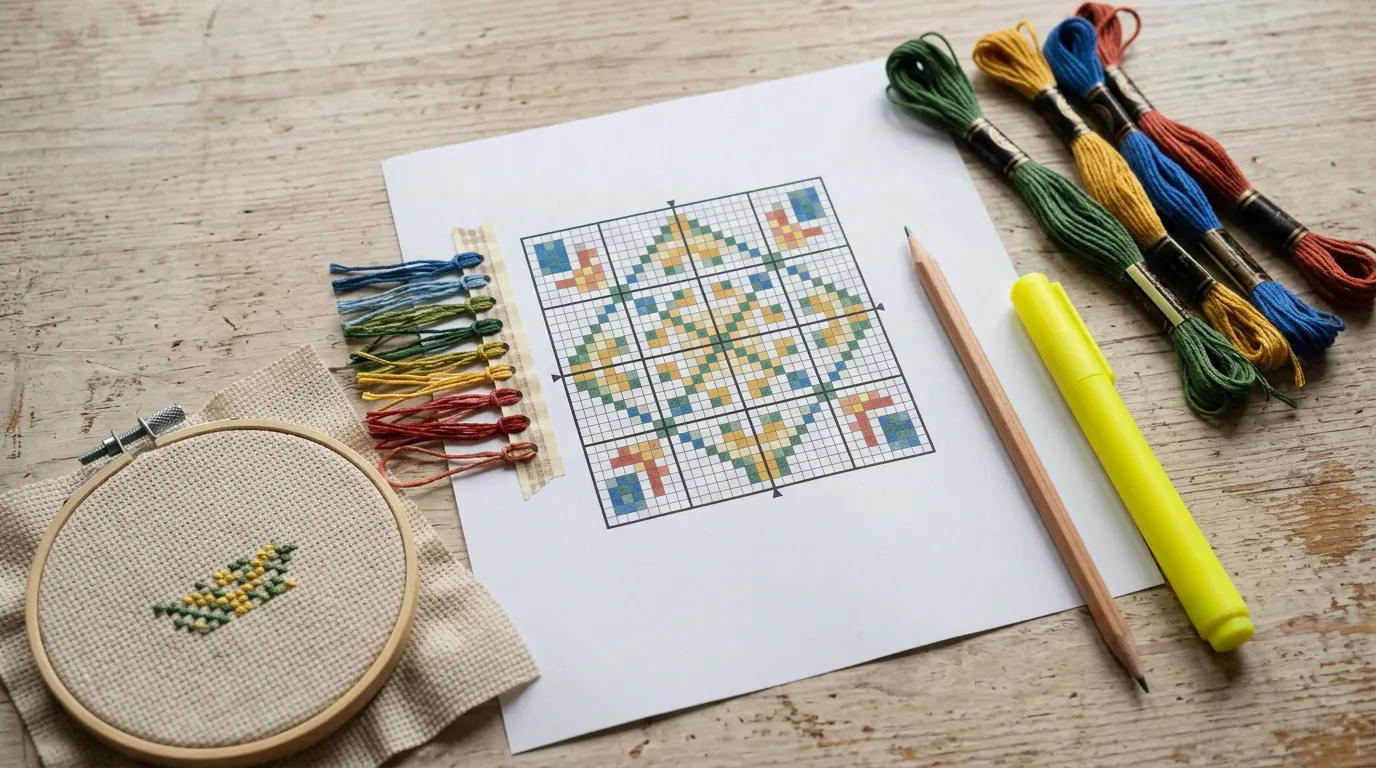
On a cross-stitch pattern each square of the grid is one stitch, and its symbol or colour tells you which thread to use, as listed in the key. Bold lines every ten squares help you count, arrows at the edges point to the centre, and lines, dots and part-filled squares show backstitch, knots and part stitches.
On this page
- The grid: one square, one stitch
- The key: symbols, colours and threads
- Bold lines and counting
- The centre arrows
- Charts on several pages
- Part stitches
- Backstitch, knots, beads and specialty stitches
- Over two on evenweave
- Reading a PDF chart on a tablet
- How Crosstela shows the same chart
- Your next step
- Questions people ask
The grid: one square, one stitch
A cross-stitch chart is a grid. Each square stands for one full cross on your fabric. On Aida, that is one square of the fabric. On evenweave or linen it is usually a cross worked over two threads each way.
The chart tells you the design’s size in stitches, such as 120 × 160. Divide by your fabric’s count to get the size in inches: 140 stitches on 14-count Aida come out at 10 inches. Leave a generous margin around that for framing.
The key: symbols, colours and threads
The key, or legend, says what each symbol means. A line usually gives:
- the symbol, and often a colour swatch;
- the thread brand and number, such as DMC 310, which is black;
- the colour’s name, and sometimes how many skeins you need;
- the number of strands, often different for crosses and for backstitch.
Symbols mean nothing on their own: the same ▲ is a different colour in every chart. Always read them against this chart’s key. When a symbol stands for two threads in one needle, a blend, the key lists both.
Some charts print symbols in black on white, some print them over colour, and some print colour only. Symbols are safest when two shades are close.
Bold lines and counting
Every tenth line of the grid is printed bolder, and the edges are often numbered 10, 20, 30. Count in tens from the nearest bold line, never square by square from the edge. Many stitchers work one 10×10 block at a time: see How to keep your place on a cross-stitch chart.
The centre arrows
Small arrows or triangles sit in the middle of each edge. Follow them across the chart: where the lines meet is the centre of the design.
To find the centre of your fabric, fold it in half one way, then the other, and crease lightly. Starting your first stitch there, counted from the chart’s centre, keeps the design centred on the cloth.
Charts on several pages
A large chart is split over pages. A small map, often on the first chart page, shows which part of the design each page holds.
Pages usually repeat a few rows or columns of the page next to them, so you can line them up. This overlap is often shaded or set off by a line. Stitch it once, from one page only.
Part stitches
Not every square holds a full cross. The key or a note on the chart shows how each is drawn:
- Half stitch: one diagonal, a single leg of the cross. Often a diagonal line or its own symbol.
- Quarter stitch: from one corner to the centre of the square.
- Three-quarter stitch: a half stitch plus a quarter stitch, usually drawn as a triangle filling half the square. Two colours can share one square this way.
- Petite stitch: a small full cross in one quarter of the square, for fine detail. It is easiest on evenweave or linen.
The stitch library shows how to make each one.
Backstitch, knots, beads and specialty stitches
- Backstitch is drawn as lines along the grid or across squares. The key has its own backstitch list, often with fewer strands. It is usually stitched after the crosses.
- French knots are dots or small circles, often on the grid lines where squares meet.
- Beads have their own symbol and a bead number in the key. They usually go on after the stitching.
- Specialty stitches, such as an eyelet or a lazy daisy, usually come with a diagram, often on a separate page.
Words you meet in keys are explained in the glossary.
Over two on evenweave
On evenweave and linen, the chart’s count is the fabric’s count divided by the threads you work over. “28-count, over two” means each cross covers two threads each way, 14 crosses to the inch: the same size as 14-count Aida.
Reading a PDF chart on a tablet
Many charts are sold as PDF files. On a tablet you can zoom into one block at a time, which is easier on the eyes than paper. Keep the key in view beside the chart, and use a highlighter tool on a copy to mark what is done.
A tracker app goes one step further: it reads the chart into squares you can mark.
How Crosstela shows the same chart
Crosstela is a free pattern tracker for iPhone, iPad and Mac. It opens a PDF chart that a pattern program saved, with its symbol key; a scan or photo of a paper chart is not read. Then:
- The key is the Palette. Every thread is listed with its symbol, code and name, and how many stitches are left. See The Palette.
- The pages become one chart. Crosstela puts the pages of the PDF together into one chart you scroll. Tools › Grid › Borders draws a dashed line where the printed pages met, with each page’s number, to compare with the paper.
- Counting help. Tools › Grid draws the tens lines and marks the centre; Rulers number the edges.
- Symbols or colours. Under Style, choose Symbols on white, Symbols + colours or Colours only, and make the symbols larger. The eye shows the finished piece. See Change how the chart looks.
- Every kind of stitch. The Palette’s Stitches tab lists each kind in the pattern (half, quarter, three-quarter and petite stitches, backstitch, French knots, beads, specialty stitches) with how many are left. Tap one to see only that kind.
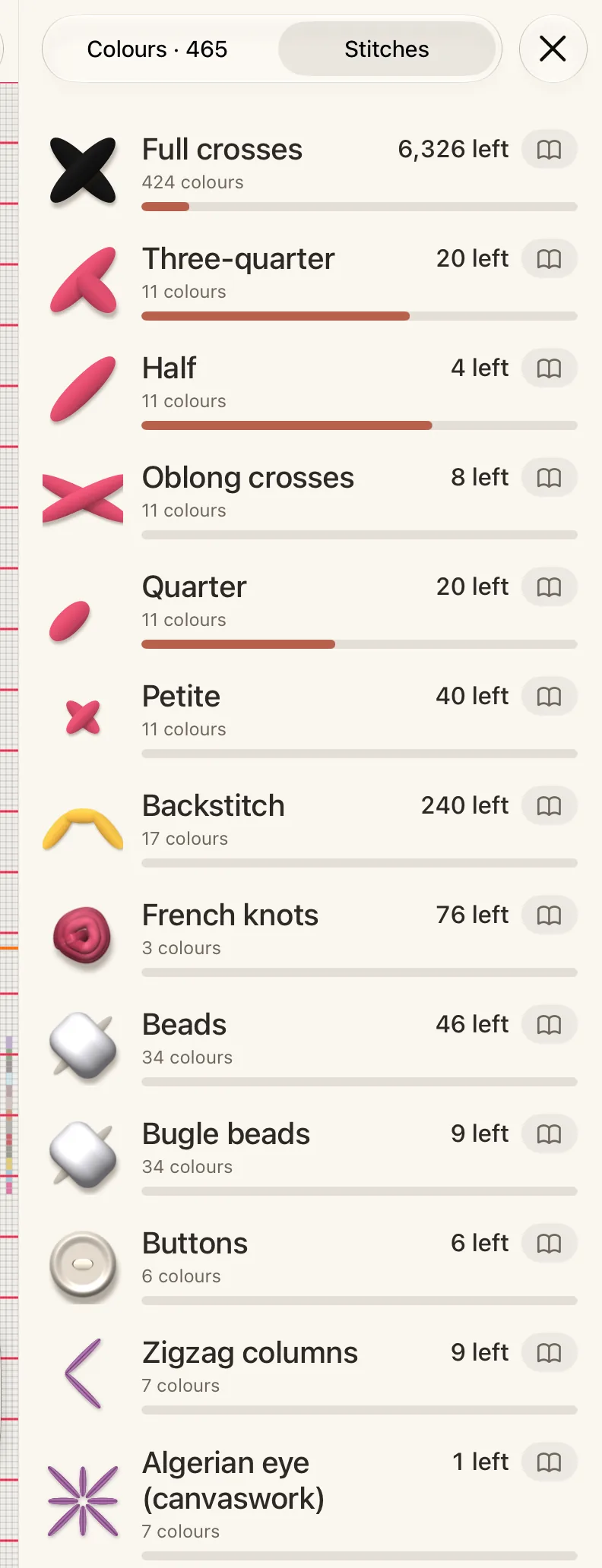
- 1Each kind and how many are left
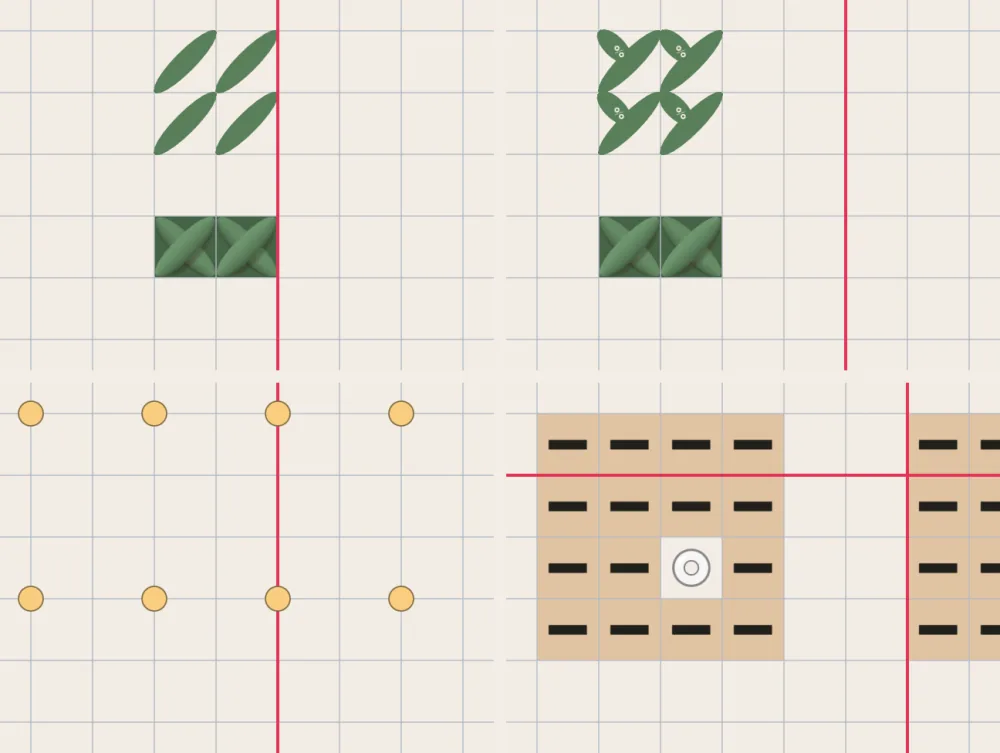
- Backstitch, step by step. Press and hold a square on a line and tap How to stitch this line: odd numbers show where the needle comes up, even numbers where it goes down. See Follow a backstitch line.
Your next step
Open a chart you own, or the free Strawberries chart, and find four things before you thread a needle: the key, the centre arrows, the bold lines every ten squares and the size in stitches. Then work out the cloth with the fabric calculator. Not started yet? What to buy and your first stitch comes first.
Questions people ask
How do you read a cross-stitch pattern?
Each square on the grid is one stitch, and its symbol or colour matches a thread in the key. Count in tens from the bold lines, start from the centre marked by the arrows, and read lines, dots and part-filled squares as backstitch, knots and part stitches.
What do the symbols on a cross-stitch pattern mean?
Each symbol stands for one thread colour, and only the chart’s own key says which. The same symbol can mean a different colour in another chart.
What do the arrows on a cross-stitch chart mean?
They mark the centre. Follow the arrows on opposite edges across the chart: where the lines cross is the middle of the design, where many stitchers start.
What does “over two” mean in cross stitch?
Each cross is worked over two threads of the fabric in each direction, as is usual on evenweave and linen. On 28-count fabric that gives 14 crosses to the inch.
How do I read a cross-stitch PDF on an iPad?
You can zoom into it in any PDF app, or open it in a tracker app. Crosstela reads a PDF chart saved by a pattern program into squares you can mark, with its key as a list of threads.